
Machine FAQs
Below you will find information on 1. ISOLDE Operation and 2. Babysitting ISOLDE which will answer many of the frequently asked questions about machine operation at ISOLDE.
1. ISOLDE OPERATION
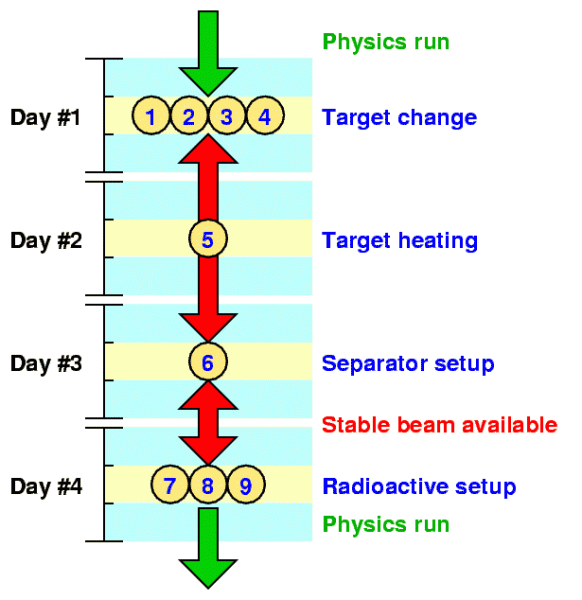
Some notes on the timing of target changes
A normal target change requires a minimum of 10 shifts. This time may increase if
Numbers 1-9 refer to the table below. |
 ? ? |
The relation between the end of one run and the start of the next is therefore:
| End of run | Start of next run |
| Monday morning | Thursday afternoon |
| Tuesday morning | Friday afternoon |
| Wednesday morning | Monday afternoon |
| Thursday morning | Tuesday afternoon |
| Friday morning | Tuesday afternoon |
Target changes and radioactive setups on Fridays are best avoided: even small breakdowns have the potential to delay the run by 3 days.
This table contains a more detailed summary of a target change. “Conflict with other separator” generally means that protons must be stopped. If the other separator is taking stable beam then there is no conflict.
| Times required to make a target change | |||||
| Action | Allow | Working hours only | Conflict with other separator | Flexible timing? | |
| Radioactive cooling for UC and ThC targets | 72 hr | ||||
| 1 | Cool old target | 2 hr | Y | ||
| 2 | Frontend to atmosphere Ventilation to access mode | 1 hr | Y | Y | |
| 3 | Put new target in zone | 1 hr | Y | Y | Y |
| 4 | Swap targets (robot) | 2 hr | Y | Y | |
| 5 | Pump / heat / outgas target | 40 hr (*) | |||
| 6 | Setup source and separator | 8 hr | Y | (Y if radiation limit in HT room exceeded) | |
| 7 | Proton scan | 2 hr | Y | (parallel operation possible if CA0 not in use) | |
| 8 | Yield check | 5 hr | Y | (parallel operation possible if CA0 not in use) | |
| 9 | User consultation & beam handover | 1 hr | Y | Y | |
(*) Certain targets may require less pumping time. However, starting the HT with a less-than fully outgassed target may cause sparking in the frontend. Excessive sparking is known to damage the frontends. We therefore take a conservative approach, and try to ensure that targets are thoroughly outgassed before they are used.
2. BABYSITTING ISOLDE
A document containing detailed information about the points below concerning the running of machines at ISOLDE can be found via https://edms.cern.ch/file/1110036/1/Babysitting_ISOLDE_from_the_CCC.pdf
1. Introduction
2. Monitoring of ISOLDE and troubleshooting
2.1 VISTAR
2.2 Workingsets
2.3 Target HT
2.4 ISOLDE Vacuum Control
2.5 LASER alarm
2.6 REX linac RF
3. If there is no beam reaching the experiment
4. Contacts and references